Drop off your CV
We'd love to hear from you. Send us your CV and one of our specialist consultants will be in touch.


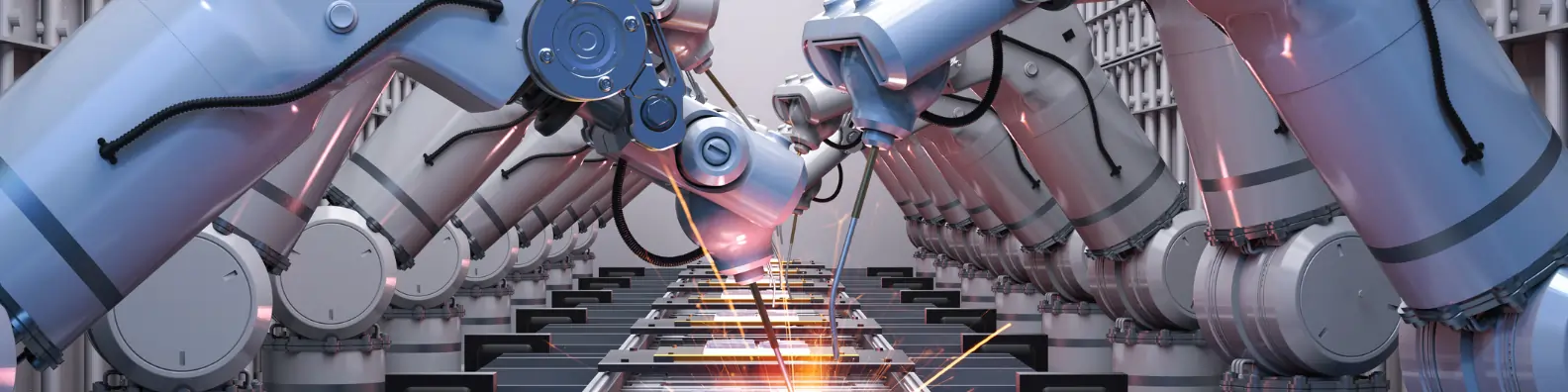
Factory automation has traditionally relied on systems designed to follow fixed instructions, which delivers efficiency in stable production environments but offers limited adaptability when conditions change. AI is changing that by enabling factories to analyse operational data in real time, predict issues, and make faster decisions across production environments, turning connected automation into a more intelligent and responsive operating model.
In this article, we explore how AI is transforming factory automation in manufacturing, the technologies driving adoption, and what this means for the future of industrial operations and hiring.
Contact CSG Talent to future-proof your leadership team.
The value of AI in factory automation depends entirely on data. Modern factories generate huge volumes of operational information through:
However, factory data is often split between separate systems, which forces manufacturers to react to maintenance, quality, and production issues after they cause costly downtime. AI solves this by turning isolated data into real-time insights, allowing teams to predict issues and optimise workflows proactively.
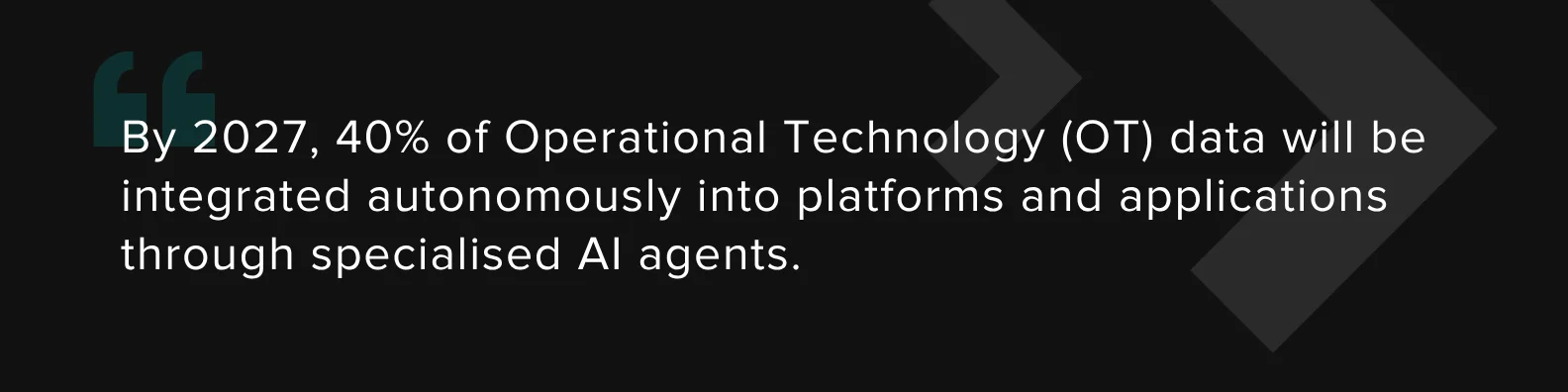
That shift is becoming increasingly important as manufacturers look for new ways to protect margins and reduce operational risk. Gartner predicts that by 2027, 40% of Operational Technology (OT) data will be integrated autonomously into platforms and applications through specialised AI agents, highlighting how factory data is becoming a strategic asset in modern manufacturing.
Predictive maintenance uses AI models trained on live machine data to identify early failure indicators before they escalate into downtime. Sensors embedded in equipment continuously capture signals such as vibration patterns, heat variation, and acoustic changes, which AI systems analyse against performance standards for each asset. When subtle deviations appear, alerts are triggered well before a fault becomes visible through standard monitoring.
This allows maintenance to be carried out based on actual asset condition rather than fixed service intervals, which improves equipment reliability and removes unnecessary servicing. The commercial impact is significant, with predictive maintenance typically reducing unplanned downtime by up to 50% and cutting maintenance costs by 18% to 25%.
AI-powered quality control systems use computer vision to precisely inspect products in real time as they move through production lines. These systems detect surface defects, inaccurate dimensions, and assembly issues within milliseconds, allowing corrections to be made immediately within the production cycle.
This timing is crucial, as defects identified early in the process prevent additional resources and labour being put into a faulty product. Quality control becomes part of the production process itself rather than a separate inspection stage, improving consistency and reducing scrap rates in high-volume manufacturing environments.
AI-driven process optimisation works by continuously analysing production variables such as machine speed, temperature, material flow, and energy usage, then adjusting these parameters in real time to improve output and efficiency. This improves overall equipment effectiveness without requiring manual intervention for each adjustment.
A digital twin is a live virtual replica of a physical factory that mirrors real-time data from machines, systems, and production processes. It allows manufacturers to simulate changes to production environments before applying them, using real operational data rather than theoretical assumptions.
This enables production teams to test scenarios such as line speed increases, layout changes, or process modifications without interrupting live operations. The main benefits of this are improved decision-making and lower implementation risk, particularly in complex environments where even minor changes can have significant downstream effects.
AI-enabled robotics includes autonomous mobile robots (AMRs) and collaborative robots (cobots) that operate with more flexibility than traditional fixed-path systems. These machines use computer vision, sensors, and AI-driven navigation to adapt to changing environments, enabling material transport and assembly support while working safely alongside human operators.
Robots can be re-tasked or reoriented for new production requirements with much less manual reprogramming, which is particularly valuable in manufacturing environments with frequent product changes or variable batch sizes. This flexibility allows manufacturers to scale automation without the restriction of traditional industrial robotics, supporting more dynamic production models.
One of the biggest barriers to AI adoption in factory automation is that manufacturing businesses often operate with critical assets that were installed 20 to 30 years ago, while innovation in AI software and digital technologies evolves much faster. That creates an integration challenge as many legacy machines were not designed to generate usable data or connect easily into modern digital environments. They often require additional sensors or middleware before AI can be deployed effectively.
According to Cisco’s 2026 State of Industrial AI Report, 36% of industrial leaders identified technology integration as a key barrier to scaling AI, while a further 25% cited legacy infrastructure limitations, highlighting a major operational issue across manufacturing.
AI adoption increases the amount of data and connectivity across the factory floor, which creates greater cybersecurity risk. Manufacturers are creating larger attack surfaces across production infrastructure that was not built with modern cyber resilience in mind.
This is more than just an IT concern, as a cyber incident in a manufacturing environment can disrupt production, impact safety systems, compromise intellectual property, and create significant financial losses. 40% of industrial leaders cite cybersecurity concerns as a major obstacle to scaling AI, making it the most reported barrier to wider adoption.
Technology is only one side of the challenge, as AI-enabled factory automation also requires a workforce capable of deploying and managing complex systems across:
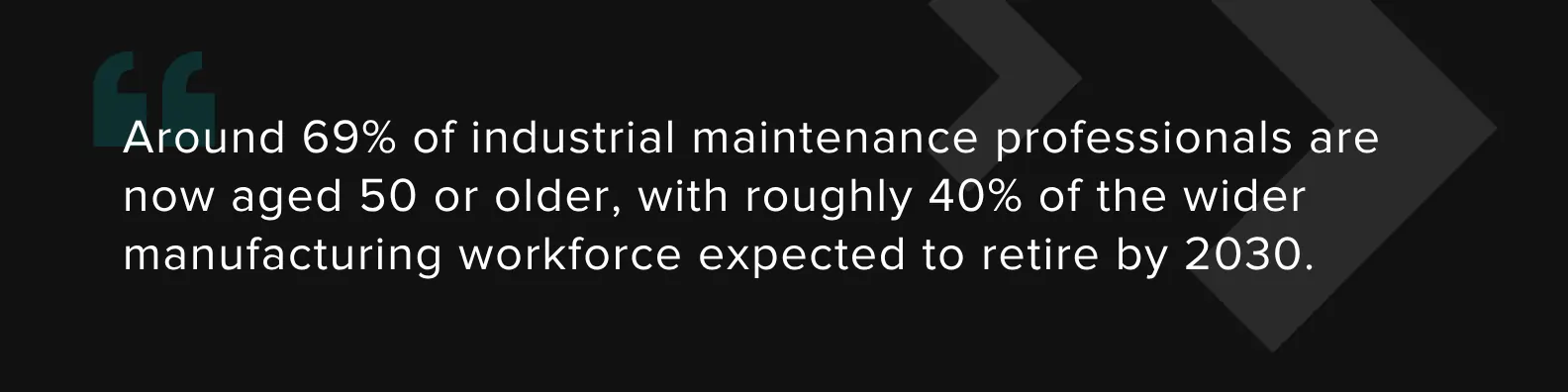
These skills gaps are becoming more prominent as experienced manufacturing talent continues to leave the workforce. Around 69% of industrial maintenance professionals are now aged 50 or older, with roughly 40% of the wider manufacturing workforce expected to retire by 2030, which puts employers under pressure to replace operational knowledge at the same time as technology requirements become more advanced.
Rockwell Automation remains one of the most influential companies in AI-powered factory automation because of its established presence on physical factory floors and growing focus on smart manufacturing software. Its investment in edge AI is helping manufacturers embed intelligence directly into hardware, allowing machines to make real-time safety, quality, and efficiency decisions without relying on cloud connectivity.
Siemens has become a leader in industrial AI through its digital twin capabilities, allowing manufacturers to simulate and validate production environments virtually before making physical investments. It specialises in connecting operational technology with digital infrastructure, helping businesses build more flexible and software-driven manufacturing environments.
Rather than building factory hardware itself, NVIDIA provides the compute foundation powering industrial AI applications. Through platforms such as Omniverse and Isaac, it enables manufacturers and developers to train autonomous robots, run factory simulations, and support AI-driven vision and robotics systems at scale.
Companies such as Symbotic and Agility Robotics represent the next wave of AI-powered physical automation. Symbotic is advancing warehouse automation through AI-driven robotic coordination, while Agility Robotics is helping push humanoid robotics into environments designed for human workers, highlighting how AI is beginning to reshape how physical tasks are executed.
IBM continues to play a major role in industrial AI through analytics, asset intelligence, and large-scale operational software. By applying AI across supply chains and manufacturing operations, IBM is helping large industrial businesses improve reliability and make more informed decisions across complex global networks.
The next phase of AI in factory automation will focus on fully connected, software-driven manufacturing environments. Real-time edge AI will allow machines to make split-second decisions directly on the factory floor, while more autonomous systems will reduce the need for manual intervention across the entire production lifecycle. Human-machine collaboration is expected to become more advanced, with AI handling repetitive analysis and execution tasks while skilled workers focus on overseeing key elements such as decision-making, problem-solving, and driving strategic improvement.
Industry forecasts suggest this transformation will accelerate over the next few years. IDC predicts that by 2029, 30% of global factories will operate through centralised, software-defined automation platforms, allowing physical production environments to evolve through software updates rather than major mechanical overhauls.
While the potential of fully automated factories with minimal human involvement continues to shape the conversation, the future of AI in factory automation will not be human-free. Instead, the factories leading the next era of industrial innovation will be those that combine automation, software intelligence, and human expertise to create more agile and resilient manufacturing operations.
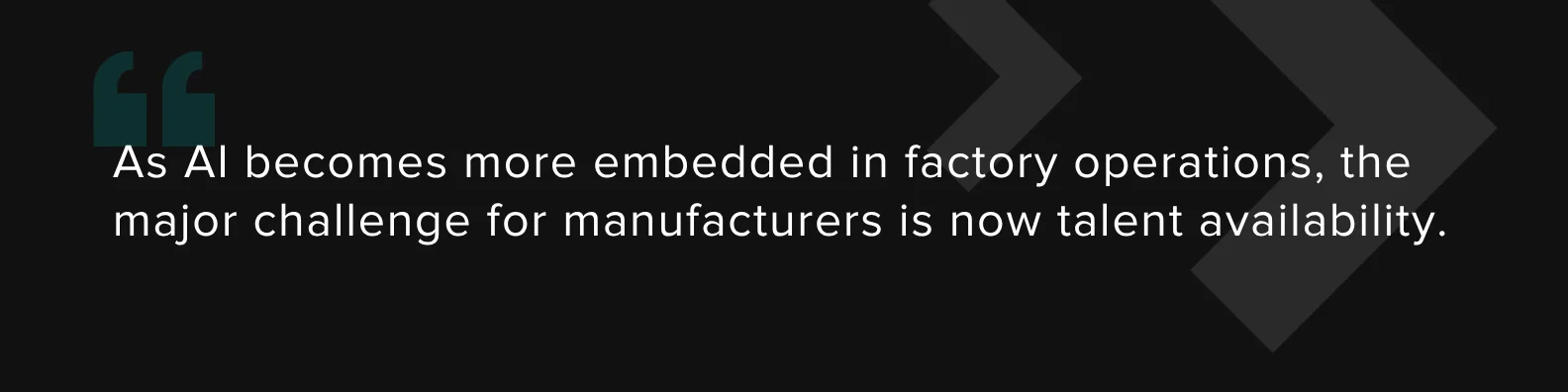
As AI becomes more embedded in factory operations, the major challenge for manufacturers is now talent availability, with demand for specialists in automation, robotics, controls, and industrial AI increasingly outpacing supply. It has become vital to build capability across engineering, data, and operations teams that can actually deliver and sustain tech infrastructure under the pressure of production.
CSG Talent works with manufacturers, industrial technology businesses, and engineering-led organisations operating in this space, supporting them in securing the specialist leadership and technical expertise needed to implement and scale advanced automation environments.
Contact our Automation Recruitment Experts to secure senior-level talent.